.png)
How to Build Muscle at Home Without Equipment (Beginner-Friendly Strategies)
- Ashley

- Sep 17, 2025
- 5 min read
Updated: Oct 8, 2025

Here’s a secret that flips the fitness world on its head: you don’t need equipment to build muscle at home. Not a single dumbbell, kettlebell, or resistance band is required. All you need is your body, a little bit of space, and a smart plan you can actually stick with.
For beginners, this is freeing—because it removes one of the biggest barriers: the idea that you can’t start until you buy gear or sign up for a gym membership. The truth is, your body is the equipment. And when you learn how to use it in the right way, you can absolutely build muscle at home without equipment and start feeling stronger, more energized, and more confident.
Let’s break down how to make it happen.
Disclaimer: This blog is designed to provide helpful tips but isn’t personalized medical advice. The content is not intended to be a substitute for professional medical advice, diagnosis, or treatment. Always seek the advice of your physician or other qualified health provider before starting a new exercise program or making changes to your health routine. For full details, see our Disclaimer & Terms of Use.
Why You Don’t Need Equipment to Get Strong
At its core, building muscle comes down to one principle: progressive overload—gradually challenging your muscles so they adapt and grow stronger. That doesn’t mean you need to load up a barbell or buy expensive equipment. It simply means you need to keep asking your body to do a little more than it did yesterday.
Most people assume progressive overload requires dumbbells, machines, or bands. But your body is an incredible tool on its own. By changing angles, increasing reps, holding positions longer, or slowing down your movements, you can create more than enough challenge to trigger strength gains.
Research backs this up. A study in the Journal of Exercise Science & Fitness found that bodyweight exercises significantly improved muscle endurance and strength in untrained individuals. That makes bodyweight training an ideal starting point for beginners who want to build strength at home without feeling overwhelmed.
Even more encouraging, bodyweight training doesn’t just build strength—it improves mobility, balance, and coordination. These benefits carry into everyday life, making simple tasks like lifting groceries, climbing stairs, or getting off the floor easier and safer. In other words, bodyweight training builds the kind of strength you’ll actually use.
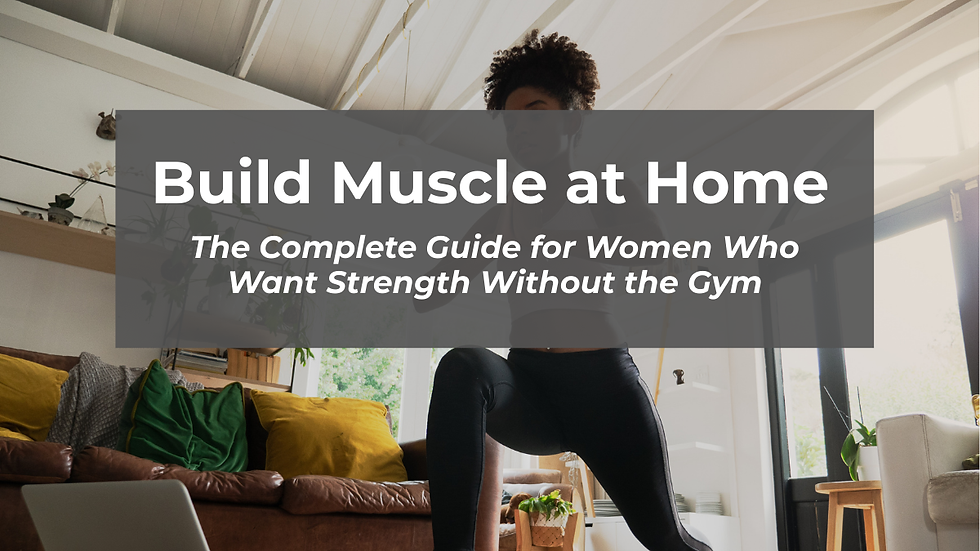
Want the full roadmap to structuring a strength plan at home? Check out my guide: Build Muscle at Home: The Complete Guide for Women Who Want Strength Without the Gym.
Beginner-Friendly Strategies to Build Muscle Without Equipment
1. Focus on Compound Moves
Compound exercises use multiple muscle groups at once, giving you more strength payoff per rep. These should be your bread and butter:
Squats (lower body, glutes, core)
Push-Ups (chest, shoulders, arms)
Lunges (legs, balance, stability)
Planks (core, shoulders, posture)
2. Use Time Under Tension
Slow down the lowering phase of your exercises. For example, take 3–4 seconds to lower into a squat or push-up. This keeps your muscles under tension longer, which encourages growth without added weight.
3. Play With Angles and Leverage
Small tweaks in body position can make an exercise harder.
Elevate your feet for push-ups.
Try single-leg squats to a chair.
Hold side planks to challenge stability.
4. Progress With Reps, Sets, and Holds
Instead of adding weight, you increase the challenge by:
Adding reps (e.g., 8 squats → 12 squats).
Adding sets (2 rounds → 3 rounds).
Adding holds (pause at the bottom of a lunge for 3 seconds).
5. Prioritize Recovery
Bodyweight training can feel easier, but don’t skip rest. Muscles grow during recovery, not just during the workout.
If you like the idea of following a simple, structured plan with all these strategies built in, join my 60-day fitness program! I've designed it to give you quick, no-equipment workouts you can start today.
A Sample No-Equipment Muscle-Building Workout
Here’s a 20-minute circuit you can try today:
Do each exercise for 40 seconds, rest for 20 seconds. Complete 3–4 rounds.
Squats
Push-Ups (or incline push-ups on a counter)
Reverse Lunges
Glute Bridge Hold
Plank Shoulder Taps
This routine covers your major muscle groups, builds core stability, and teaches you how to use your own body as resistance.
If you like the 20-minute workout route, you can see an expanded plan here: 20-minute at-home strength routine.
What You’ll Notice As You Build Strength
After a few weeks of bodyweight strength training, most beginners report:
More energy throughout the day
Improved confidence in how their body moves
Functional strength that carries over into daily life (lifting, climbing, bending)
And here’s the kicker—you can always keep progressing. Your body provides endless ways to increase difficulty.
I share progression strategies, plus how to know when it’s time to add equipment, in my guide: Build Muscle at Home: The Complete Guide for Women Who Want Strength Without the Gym.
Making Bodyweight Workouts Stick
The hardest part isn’t usually the workout itself—it’s turning it into something you do consistently. Strength comes from showing up again and again, not from doing one perfect session. Here are some simple ways to make your routine stick:
Schedule it like an appointment. Treat your 20-minute workout the same way you would a meeting or a doctor’s visit. Put it on your calendar and protect that time. Seeing it written down makes it harder to brush off.
Use habit stacking. Link your workout to something you already do every day. For example, move right after your morning coffee, or do your circuit while dinner is in the oven. The existing habit acts as a trigger to remind you.
Track your wins. Write down what you did—sets, reps, even how you felt. Over time, you’ll be able to see your progress on paper, which is incredibly motivating. Progress doesn’t always feel obvious in the moment, but when you look back, you’ll realize how much stronger you’ve become.
If you have interest in moving toward using some equipment, and you have a pair of dumbbells, you already have everything you need. Try these at-home dumbbell workouts for women.
Build Muscle at Home Without Equipment Wrap Up
Building muscle at home without equipment doesn’t have to be complicated—it just has to be consistent. The first push-up, squat, or plank you do might feel small, but those small actions add up to real strength when you repeat them over time.
If you’re unsure where to begin, I’ve made it simple for you. My 60-day fitness program gives you a complete, beginner-friendly plan with no equipment required—just clear guidance and short, effective workouts you can actually stick to. It’s the easiest way to take action today and prove to yourself that you can get stronger at home.
Comments